


2026-2030
Funding: ANR
Parterns : Limics (coord.), LIPN
Medical Text Mining and Defeasible Reasoning under Category Semantics for Large-Scale Biomedical Ontologies
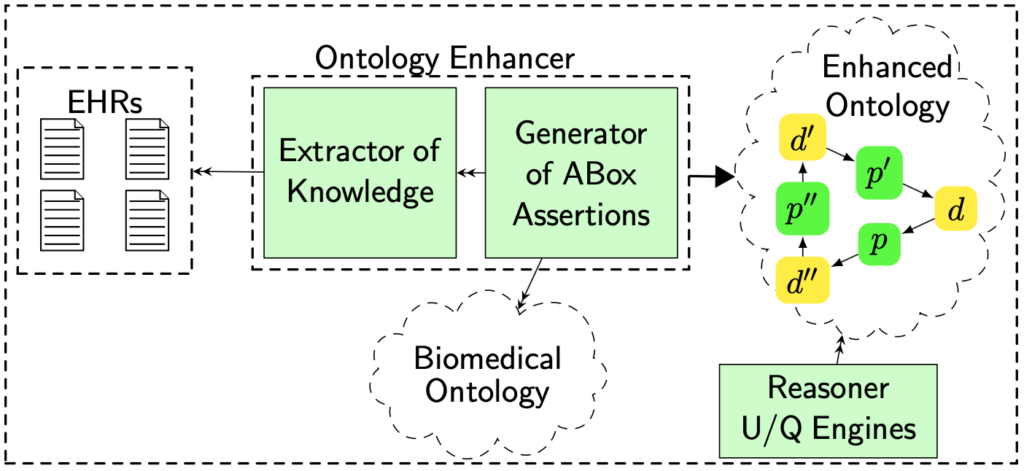
Large-scale biomedical ontologies have been developed and are mainly used for interoperability support in a complex healthcare system. Efforts have made these ontologies more beneficial in terms of reasoning. These efforts resulted in a family of OWL languages based on Description Logics (DLs). Although almost all interesting biomedical ontologies are currently expressed in OWL, their exploitation in reasoning remains limited. This is mainly due to the absence of assertional knowledge from biomedical ontologies, as well as the lack of expressiveness of underlying tractable DLs and the large scalability of existing reasoners. MEDTRECS will extend knowledge represented in biomedical ontologies and their foundation in two complementary aspects: enhancing ontologies with knowledge from medical texts and equipping underlying DLs with new logical constructors to preserve the tractability of reasoning. Regarding the first aspect, MEDTRECS will analyse medical texts, extract knowledge on negations, and populate ontologies. It will improve Large Language Models (LLM) to extract entities and relations containing negation from medical texts and improve LLM-based extractors to learn detection and extraction together. Concerning the second aspect, MEDTRECS will add to an underlying DL new constructors for representing defeasible knowledge and refine the semantics of DL constructors of the resulting DL, responsible for intractability, such as negation and disjunction. For this, we will rewrite the usual set-theoretical semantics of DLs in categorical language as a set of independent properties and drop harmful ones. MEDTRECS will also integrate the results in a reasoner maintained by the partners. The enhanced ontologies will be evaluated using open medical data from MIMIC, and the reasoner will be evaluated using the enhanced ontologies.